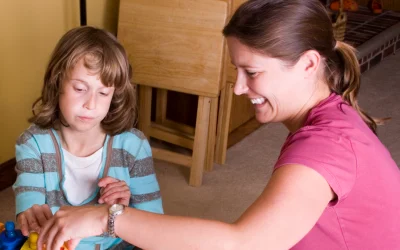
Supporting your child with autism begins at home, where they feel the most comfortable and secure. As a parent, you play a crucial role in helping your child achieve their goals, and it is important to remember that autism is not something that needs to be fixed or cured!
By embracing neurodiversity-affirming care at home, you can create an environment that celebrates your child’s unique strengths and provides them with the tools they need to succeed.
One way to achieve this is by incorporating ABA therapy techniques at home. These techniques can make a huge difference in your child’s development and give them the confidence they need to navigate the world.
Try These Effective ABA Techniques at Home
If you are looking for some inspiration on how to do ABA therapy at home, here are five powerful ABA therapy techniques for parents you can try at home to support your child’s growth:
1. Positive Reinforcement
One of the foundational ABA therapy techniques, positive reinforcement involves rewarding your child for showing desired behaviors. Whether it is a small treat, praise, or extra playtime, positive reinforcement encourages children to repeat these behaviors. This technique works especially well in creating long-term behavioral changes, as it helps your child associate positive actions with positive outcomes.
2. Discrete Trial Training (DTT)
Discrete Trial Training breaks down complex tasks into smaller, manageable steps. This form of ABA therapy at home can be particularly effective for teaching new skills, from communication to problem-solving. By working on each part of a task separately and rewarding progress, you can help your child build confidence while mastering everyday tasks.
3. Prompts
Prompts are another effective ABA therapy technique for parents to use at home. Prompts guide your child towards the correct response or behavior, whether it is a physical prompt like hand-over-hand guidance or a verbal prompt like giving instructions. Over time, you can gradually reduce the prompts, allowing your child to complete the task independently.
4. Reinforcement Schedules
Using reinforcement schedules is about timing your rewards effectively. Note that you do not have to give immediate rewards every single time. Instead, you can use reinforcement schedules that fit your child’s needs, whether it is providing rewards after a set number of correct responses or using intermittent reinforcement.
5. Generalization Training
Generalization training is key to ensuring that the skills your child learns are applied in different settings and situations. This type of ABA therapy at home allows you to create real-world opportunities for your child to apply what they have learned, helping them to become more adaptable and successful in various environments!
Compassionate In-Home ABA Therapy Programs for Children
At Advanced Behavior Analysis, our mission is to help children throughout Utah achieve a brighter future through ABA therapy. Our custom ABA therapy programs are designed to support neurodiversity-affirming care, ensuring that each child’s unique strengths are celebrated and nurtured.
If you are interested in learning more about how custom ABA therapy can transform your child’s life, we offer services across Utah and are here to guide you every step of the way!
Contact us today to chat with our team about how ABA therapy techniques for parents or how to enroll your child in ABA therapy at home!skill development.